
Westra’s binder replaces PVDF and conductive additives with one PFAS-free conductive cathode binder.
Cathode binders in lithium-ion batteries rely on fluorinated materials to deliver stability and performance.
PFAS are highly persistent and do not degrade, leading to long-term environmental accumulation. At the same time, increasing regulatory pressure is driving industries to phase out fluorinated materials.
For battery manufacturers, this creates a clear challenge: how to maintain performance while moving away from materials that are no longer viable long term.
At the core of Westra’s technology is a conductive polymer binder that provides mechanical integrity, adhesion and high electrical conductivity in a single material.
By integrating these functions, the binder replaces two conventional electrode materials, PVDF and conductive additives such as carbon black or carbon nanotubes, with a single material, simplifying the electrode formulation.
Westra’s conductive binder simplifies electrode formulations and demonstrates strong compatibility with LFP and NMC active materials.
By eliminating the need for conductive additives, the technology enables higher energy density and improved electrochemical performance.
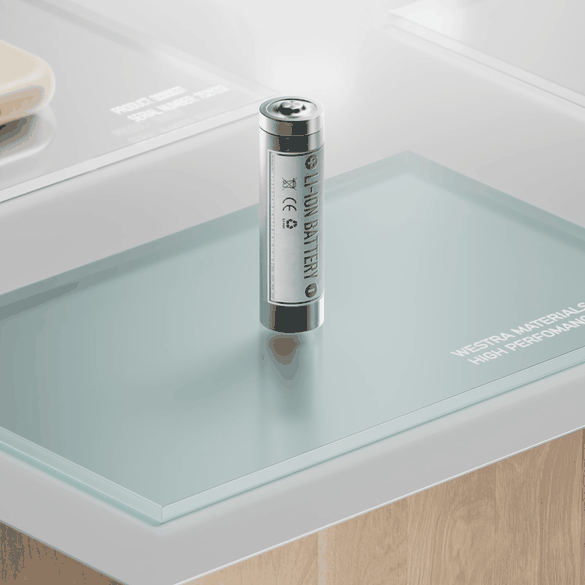
Lithium-ion batteries rely on fluorinated binder materials that require processing in hazardous solvents such as NMP. Westra’s binder contains no fluorine and is therefore 100% PFAS-free, offering a safer and more sustainable alternative.
By replacing both PVDF and conductive additives with a single material, the binder simplifies electrode formulation and supports efficient manufacturing. The binder can also be dispersed in organic solvents such as DMSO, offering the possibility to replace toxic NMP for slurry processing.
As PFAS regulations evolve globally, Westra’s technology provides a future-ready solution without compromising performance.